
The term NASA satellite evokes images of spacecraft orbiting Earth, gathering crucial data about our planet and beyond. A NASA satellite plays a vital role in modern science: from tracking climate change to observing natural disasters. In this article, we explore how a NASA satellite recently captured a groundbreaking view of a tsunami — and why that matters for science, safety and our understanding of Earth.
How a NASA Satellite Works
A NASA satellite is typically equipped with advanced sensors or radar instruments that monitor the Earth’s surface, oceans, atmosphere, or outer space. These satellites orbit the Earth and send data back to scientists — allowing global observations without needing to be physically present. For example, some NASA satellites map ocean surface heights, others track land movement, weather patterns, or changes in ice cover.
By providing continuous, high-resolution data over vast areas, a NASA satellite can detect subtle or large-scale changes that would be impossible to monitor solely from the ground. This helps researchers monitor environmental shifts, natural hazards, and long-term Earth system changes.
History and Evolution of NASA Satellite Missions
Over decades, NASA has deployed numerous satellites for different purposes: Earth observation, planetary science, astronomy, and climate research. Each NASA satellite mission builds on past lessons, with improving sensor resolution, data transmission, and coverage area.
Recent generations of NASA satellites — especially Earth-observing satellites — are more capable than ever. They combine radar, altimetry, imaging, and other techniques to deliver detailed information on land, water, ice, and atmospheric conditions. This evolution has transformed not only scientific research, but disaster monitoring, climate policy, and environmental conservation.
Important NASA Satellite Achievements
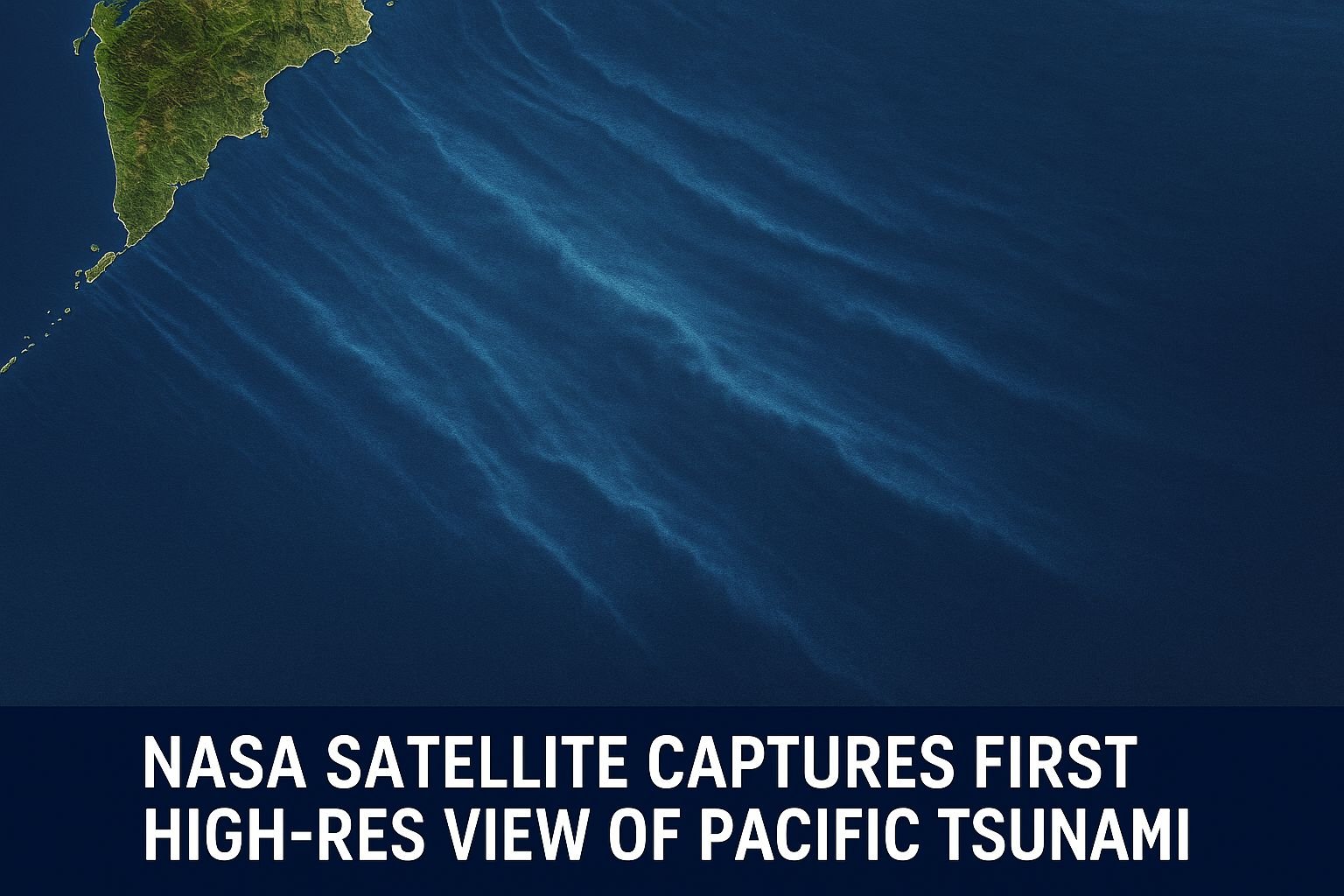
One of the most recent and dramatic successes of a NASA satellite came when a satellite captured, for the first time ever, a high-resolution space-based view of a giant Pacific tsunami.
First spaceborne capture of a major tsunami
On 29 July 2025, a powerful earthquake (magnitude 8.8) off the Kamchatka Peninsula in the Kuril-Kamchatka subduction zone triggered a massive tsunami that traveled across the Pacific Ocean. Rather than relying solely on seafloor buoys, researchers got an unprecedented view using a NASA satellite — revealing detailed wave patterns across the ocean surface.
The satellite in question, part of a NASA mission, detected not a simple, single wavefront, but a complex network of waves — interacting, dispersing, and spreading across a swath up to ~120 kilometers wide.This challenges previous assumptions about how large tsunamis propagate.
Why NASA Satellite is Crucial for Earth Observation
The ability of a NASA satellite to observe vast oceanic phenomena from space — including events like tsunamis — makes it a powerful tool for Earth observation. Traditional tsunami detection systems, like deep-ocean buoys, only measure at discrete points and provide limited spatial information.
In contrast, a NASA satellite can survey huge ocean areas in one pass. In the recent tsunami event, the satellite provided a continuous, two-dimensional “snapshot” of the wave field mid-ocean — something previously impossible.
This comprehensive view helps scientists better understand how tsunamis evolve, how energy disperses in the open ocean, and how wave behavior might change before reaching coastlines. Such data is invaluable for improving tsunami forecasting, hazard assessment, and early-warning systems.
Role of NASA Satellite in Climate Tracking and Disaster Forecasting
Beyond tsunamis, NASA satellites monitor other Earth systems: sea-level rise, changing ocean currents, melting ice caps, deforestation, weather patterns, and atmospheric gases. These observations are critical for tracking climate change, environmental degradation, and natural hazards.
By combining satellite data with other measurement systems (ground sensors, buoys, seismic data), researchers can build more accurate models to forecast disasters — hurricanes, floods, tsunamis — and understand long-term shifts in Earth’s environment.
NASA Satellite and Space Exploration Beyond Earth
While many NASA satellites focus on Earth, others explore space: studying the Sun, distant planets, stars, and galaxies. The technology developed for Earth-observing NASA satellites — advanced sensors, radar, imaging — often overlaps with instruments used for deep space missions.
Thus, NASA satellites serve a dual purpose: defend and understand our home planet, and extend human knowledge beyond Earth.
Future Projects and Upcoming NASA Satellite Innovations
The recent success capturing a tsunami suggests that future NASA satellite missions should — and will — incorporate disaster monitoring more explicitly. As satellite sensors improve, they may offer near-real-time tracking of ocean and atmospheric events.
Moreover, collaborations between agencies (both national and international) may expand the scope and reach of NASA satellite missions, combining radar, optical imaging, altimetry, and other sensing techniques to build a more comprehensive Earth-observation network.
Conclusion: Transforming Human Knowledge from Space with NASA Satellite
A NASA satellite is not just a tool of exploration — it is a powerful instrument for safeguarding and understanding Earth. The recent space-based observation of a giant Pacific tsunami underscores how vital these satellites have become. As data from NASA satellites continue to enrich science, policy, and safety, we are entering a new era where the planet’s most complex phenomena can be watched, understood, and — hopefully — predicted before they impact human lives.
The remarkable achievement of a NASA satellite in capturing tsunami wave patterns from space highlights the transformative power of satellite technology — for science, for Earth, for humanity.
Read More: Total Headline